
In January 2023, a 24-year-old internet entrepreneur looked into a camera and made a declaration: any man in his twenties who doesn’t drive a Lamborghini should have a serious discussion with himself about why.
Scraping together $200,000 to buy one was, in his words, “so incredibly easy.” Money was everywhere. Two hundred grand was just “chump change.”
When I watched the clip, I had a single thought: I hope my kids never see this crap, but I know they will.
Algorithms pushed the video to millions for a simple reason: human nature has a deep, incurable weakness for confusing looking rich with being wealthy.
The internet loves a shortcut. And telling young men that the absence of a $200,000 sports car is a personal character flaw turns out to be a very profitable way to get attention.
The Scoreboard Is the Product
When you see someone driving a $200,000 supercar, the only thing you know about their financial balance sheet is that they have $200,000 less than they did before they bought it—or a monthly lease payment that would give most people an ulcer.
Wealth is what you don’t see. But on social media, the illusion is the business model.
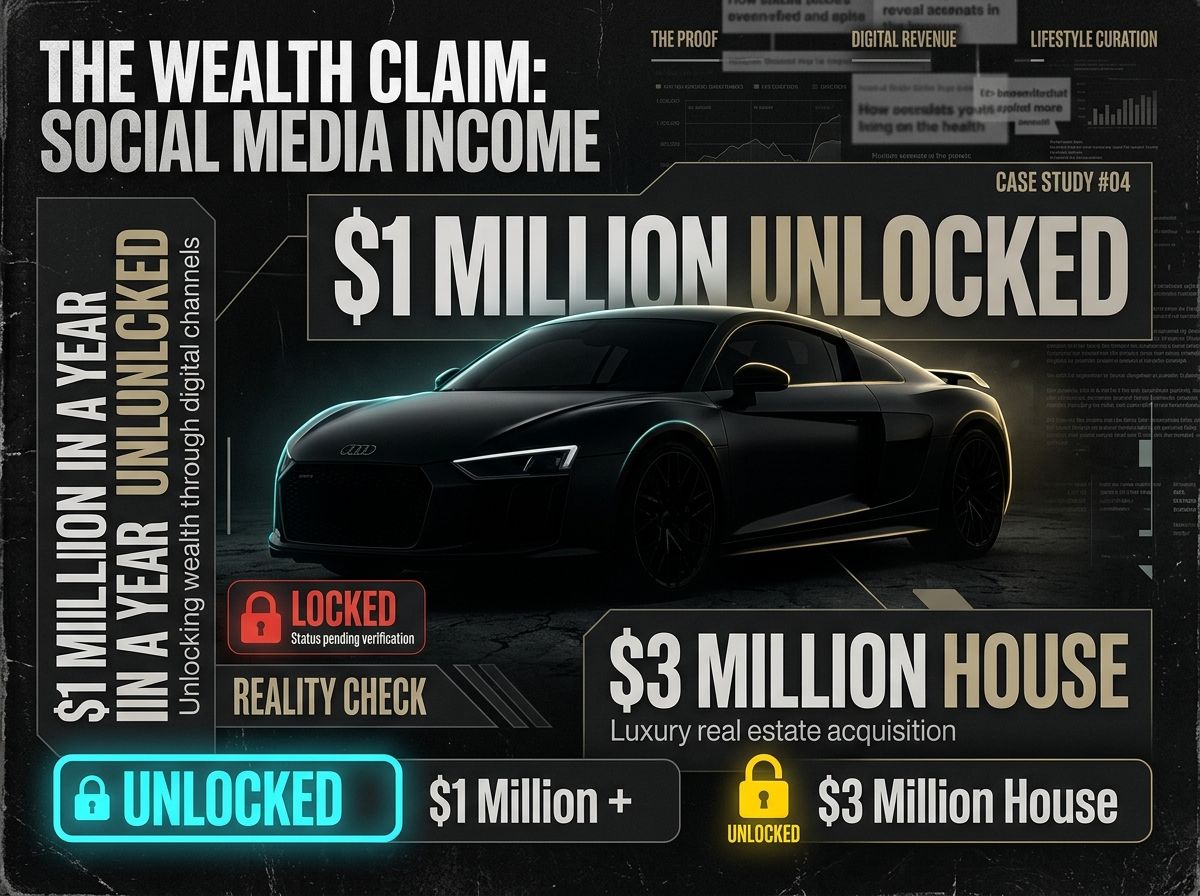
In one post on X, the creator listed his achievements like levels in a video game: $1 million earned, unlocked; $1 million in a year, unlocked; $1 million in a day, still locked. Another post cataloged an Audi R8, a commercial truck, a $3 million house under construction, and a seven-figure company.
None of this was audited. It didn’t need to be. These weren’t financial statements; they were flashy numbers designed to capture a teenager’s attention span.
When people mocked the video, he posted the resulting news coverage and noted that people would pay $100,000 for that kind of promotion.
That is the genius of the status game: admiration buys the image, and outrage distributes it for free.
Making Honest Labor Look Like Failure
Get-rich-quick culture relies on a subtle trick: it recasts honest labor as a sucker’s bargain.
A steady job is framed as a lack of courage. Patience is called a lack of vision. The years spent learning a trade, building a reputation, and fixing your own mistakes are dismissed as tedious noise—a slow prelude to a life that should have started with a viral sales funnel.
Mike Rowe has spent two decades arguing that work is suffering from a massive branding crisis. In 2017, he wrote, “For many people, work has become the enemy.”
The Lambo cult turns that cynicism into a business model: work is the cage, the guru has escaped, and his supercar is Exhibit A.
The Dignity of the Apprentice
Rowe’s hit show Dirty Jobs painted a radically different picture of human satisfaction.
He called himself a “perpetual apprentice.” He spent years traveling to all fifty states, working alongside pig farmers, electricians, plumbers, bridge painters, and crab fishermen—people whose mastery became obvious the second an amateur tried to replicate it.
He showed up ready to look foolish, listen to people who knew more than he did, and follow instructions.
The show wasn’t really about dirt. It was about the dignity of work that keeps civilization running. It suggested that work should be judged by a simple standard: Does it solve a real problem, and does the person doing it take pride in doing it well?
Steel-toed boots don’t hold a monopoly on honest labor. Software developers, nurses, accountants, teachers, small business owners, and stay-at-home parents all serve real human needs outside their own ego. Honest work points to something beyond yourself: a pipe fixed, a child kept safe, a spreadsheet balanced, or a product built.
Rowe tells a story about Bob the Pig Farmer, who collected leftover food from Las Vegas buffets to feed to livestock. Bob never dreamed of doing this as a boy. Yet Rowe found him extraordinarily happy and successful. He hadn’t chased a fantasy; he found an overlooked problem and solved it.
As Rowe put it: “Passion works better as an adverb.” It describes how you do the work, not a magical occupation waiting to rescue you from effort.

My Minivan Has a Better Job
My daily driver is a black Toyota Sienna.
It features a thriving ecosystem of stray crumbs and several fossilized French fries wedged into tight plastic crevices—crevices clearly designed by an engineer with a personal grudge against vacuum cleaners. It carries my wife and our two boys.
No one pulls up next to my minivan at a red light and wonders if I’ve unlocked a secret stream of passive income. Its automatic sliding doors will never establish dominance.
But the van succeeds at the exact job I bought it to do.
And to me, that is the literal definition of wealth.
Real wealth is quiet. It has very little to do with what you show people to impress them and everything to do with the options you retain behind closed doors.
A rich life means having people worth carrying and somewhere meaningful to take them. It means paying your bills without drama, and keeping enough financial margin to absorb the unexpected breakdown that always arrives at the worst possible time.
It means doing work you can respect long after the invoice is paid. As Rowe noted, a paycheck is only one benefit of a job well done.

Freedom Without the Thumbnail
The research backs this up. A 2026 meta-analysis of 192 workplace studies linked autonomy, mastery, connection, and internal motivation directly to long-term job satisfaction and well-being.
We thrive when we have some control over our labor, a chance to get better at it, and people to share it with.
Work can be tedious. Bosses can be tyrannical. Opportunity is never distributed evenly. That is precisely why financial independence matters: money gives you options. The freedom to choose meaningful work—or walk away from a toxic environment—is infinitely better than escaping effort entirely.
But that freedom grows at an agonizingly slow pace.
It starts by spending less than you make and building an emergency fund to protect you from life’s surprises. The Federal Reserve’s 2025 household survey highlighted just how rare that basic buffer is: only 55 percent of adults had three months of expenses saved, while 30 percent had no way to cover it.
After savings comes time. The formula on Investor.gov summarizes wealth-building in a sentence far too boring for a YouTube thumbnail: “regular investments + time → wealth.”
Compounding requires decades of doing unsexy things consistently. Markets swing, returns fluctuate, and diversification manages risk rather than eliminating it. But this approach has one decisive advantage over the Lamborghini sermon: it doesn’t require $200,000 to be “chump change” before you can start.
No one goes viral for setting up an automatic index fund contribution, keeping fees low, and sitting on their hands during a flat decade. But sensible personal finance isn’t about applause. It’s about letting small, quiet choices accumulate until they harden into freedom.
What the Money Is For
That is the philosophy behind FITools. It views personal finance as a cohesive whole: choosing durable work worth doing, saving your first dollar, building enough wealth so you don’t have to work, and living comfortably off what you’ve built.
For most of us, the technical advice is simple: buy low-cost index funds, hold them, and get on with living.
The harder question is deciding what kind of life you want the money to make possible.
My answer won’t fit inside a supercar.
It’s a black minivan with crumbs in the seams, shriveled French fries in crevices I can’t reach, and plenty of room for all four of us.